
War and Peace
Time, Patience, and Living After Loss

You don’t review War and Peace. You metabolize it. Like the Mona Lisa, it’s famous — everyone’s heard of it, few have truly seen it. Reading it is less about literary critique and more about joining a fraternity of those who’ve walked its terrain. For me, it became a lesson in time and patience, and ultimately, in how we live after loss.
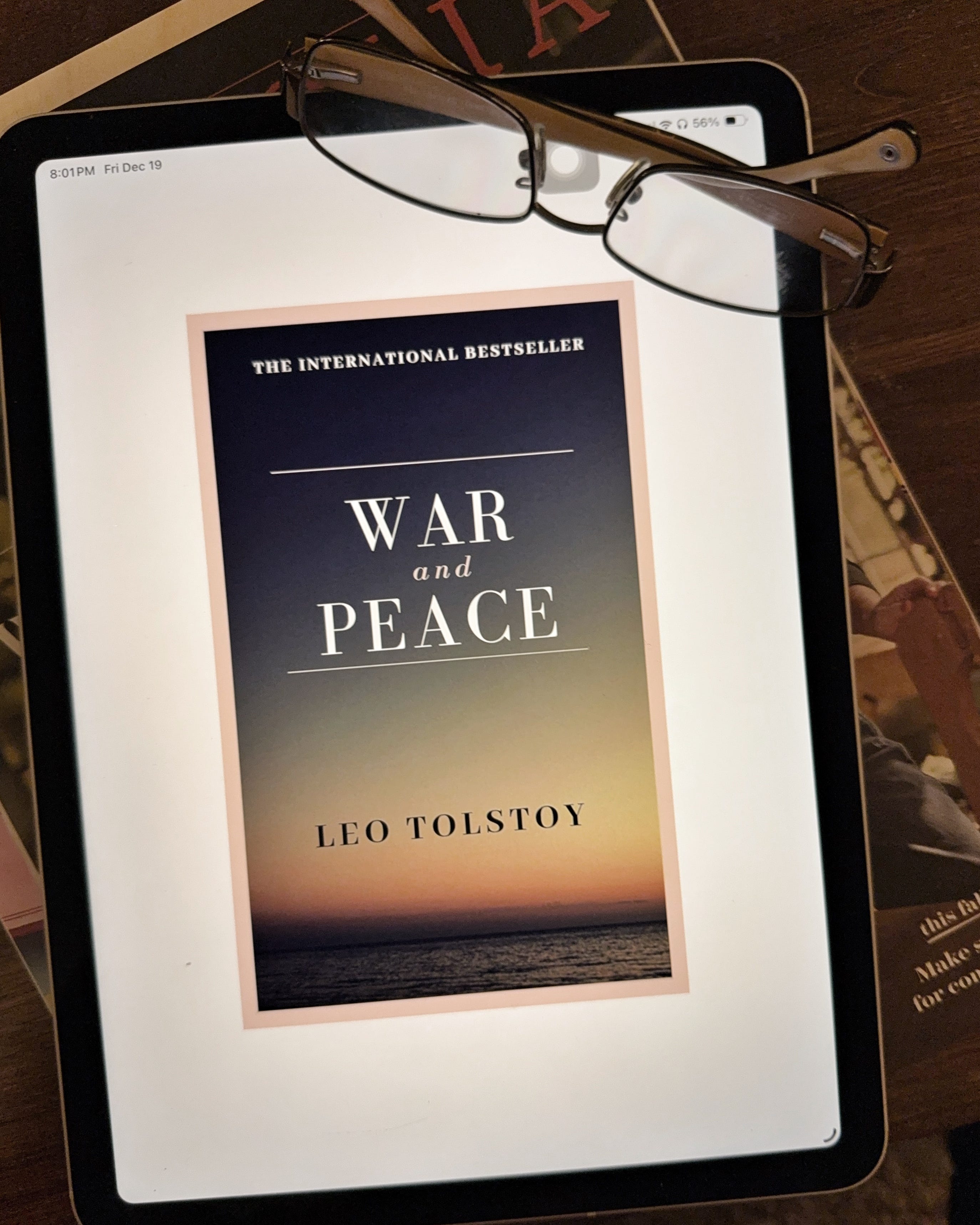
It’s not just a book — it’s a rite. And when I described my slow read to an old college friend this June, her jaw dropped. She said she’d never even considered reading it. That moment — her surprise, her delight — reminded me that this journey is worth sharing. Because this book changed how I read. It rewired my expectations. It taught me to sit with silence, with rupture, with the refusal of narrative comfort. Tolstoy doesn’t make it easy.
Years ago, a colleague once told me how good it was. She even visited the battlefield at Yorktown to better understand the military tactics Tolstoy described. That stayed with me. And now, having read it slowly over the course of a year, I understand what she meant.
I spent three weeks in July and August reading Tolstoy’s account of the battle of Borodino — right in the middle of rebuilding after the flood. I will probably always remember that period, not because my experience was anything like the soldiers who fought there, but because Tolstoy’s chapters became a mirror. The chaos of war layered against the chaos of reconstruction, the exhaustion of soldiers echoing my own fatigue. The battles aren’t just historical — they’re emotional architecture.
Petya’s death shocked me. I reread those pages several times, trying to make sense of it. But there is no sense. That’s Tolstoy’s brilliance. He refuses narrative comfort. He lets grief rupture the rhythm. And Pierre’s captivity, followed by Dolokhov’s unexpected rescue, reframes everything. You expect resolution, but Tolstoy gives you reckoning.
Reading it slowly — week by week, season by season — was the right choice. It let full impact of the novel settle. It let Natasha’s grief deepen, Pierre’s transformation unfold, and Andrei’s resignation about his death soften into acceptance. It also gave me space to appreciate Tolstoy’s essays on history, great men, and his utter dislike of Napoleon. And yes, I came to appreciate his view.
“The strongest of all warriors are these two — Time and Patience.” Tolstoy’s words echo through Petya’s death, Andrei’s resignation at his own death, and Pierre’s rebirth.
Simon Haisell’s weekly Substack reviews were my Tuesday ritual. He tied threads together with clarity and care, offering insights that deepened the experience. In his review of the final book in War and Peace, he asks: How do we live our life when someone has gone? That question stopped me cold. It’s the question Tolstoy leaves us with after Petya’s unexpected death, after Andrei’s acceptance, after Kutuzov fades away. And the answer, through Natasha and Pierre, is simple and profound: by loving others.
Moving forward, I’m a believer now in the slow read. In 2026 I plan to join Simon’s Wolf Crawl. First by reading the weekly summaries of Wolf Hall and Bring Up the Bodies, and then joining in to read the final book of Hilary Mantel’s trilogy, The Mirror and the Light.
This is part of an irregular series of books that resonate.
Not just dispatches. Not quite reviews. But if it lingers, I recommend it.
If it calls to you, feel free to share.